How do I know if my process is ready for automation?
A medical device manufacturing process is ready for automation when it has documented process flows, stable product specifications, clear performance targets and the internal resources to support the system long term. In regulated MedTech environments, it also needs a validation plan and change control in place. Use the readiness checklist below to see where your process stands and what to address before you engage an automation partner.
“We need to automate this process” is a phrase we hear quite regularly from MedTech manufacturers who are facing increasing pressure to improve quality, reduce costs and scale their production. Manual assembly lines that once met demand are now bottlenecks. Quality issues that were once manageable are becoming critical and labour costs/workforce availability concerns are on the increase.
Automation seems like the obvious solution. But here’s what 20+ years of designing custom automation systems has taught us: not every process is ready for automation, and that’s perfectly okay.
The Hidden Cost of “Not Ready”
Last year, we worked with a medical device manufacturer who needed immediate automation. Their manual assembly process was causing quality issues, and they were under pressure to increase throughput. The problem centred around the fact that their process documentation was incomplete, product specifications kept changing, and they hadn’t defined clear success metrics. Six months later, after investing significant time and resources, the project stalled.
However, there was a positive outcome. Once the time was taken to properly prepare, the automation project became one of our most successful implementations, delivering a 200% throughput increase and virtually eliminating quality defects.
What Makes a Process “Automation Ready”?
With over 20 years of experience working on MedTech automation projects, we’ve identified the essential readiness factors. Master these, and your automation project has an excellent chance of success. Miss them, and you’re setting yourself up for delays, cost overruns and frustration.
-
- Build A Foundation (Documentation & Specifications)
Before any engineering work begins, you need a clear understanding of your current process. This means detailed process flows, comprehensive product specifications, and realistic performance targets. Think of it this way, if you can’t explain your process clearly to a human, how can you expect to program a machine to execute it?
- Build A Foundation (Documentation & Specifications)
-
- Define Your Framework (Requirements & Environment)
Every successful automation project requires clear boundaries. What level of automation do you actually need? What are your space constraints? What’s your realistic timeline? These aren’t “nice to know” details, they’re essential for your projects success.
- Define Your Framework (Requirements & Environment)
-
- Set Up A Support System (People & Processes)
The best automation systems fail without proper support structures. Who will manage the project internally? How will the system be maintained? What happens when issues arise? These human factors often determine long-term success more than technical specifications.
- Set Up A Support System (People & Processes)
What makes medical device automation different?
Every automation project needs solid documentation and clear requirements. In medical device manufacturing, regulatory expectations raise the bar further. These are the factors we see most often deciding whether a MedTech project runs smoothly or stalls.
Product design freeze
Automating a product that is still changing is one of the most common causes of delay. Tooling, vision inspection and handling are all built around a product’s specific geometry, so late design changes can mean rework and revalidation. Aim to have your product design frozen, or at least confirm which features may still change, before detailed machine design begins.
Validation planning
Automated equipment used in medical device production typically needs to be validated through Installation, Operational and Performance Qualification (IQ, OQ and PQ). Planning validation from the start, including who owns each protocol and what acceptance criteria apply, avoids surprises at Factory Acceptance Testing and on site.
Quality system alignment
Your automation project should fit within your existing quality management system. Think about how the equipment will be documented, how risk will be assessed and how deviations will be handled.
Change control
Once a validated system is running, every change matters. Agree early on how software updates, spare part substitutions and process adjustments will be managed and documented.
Traceability and data
Many MedTech processes require part-level traceability, from laser marking and UDI to vision inspection records. Define what data the system must capture, where it will be stored and who needs access to it.
Your Automation Readiness Assessment
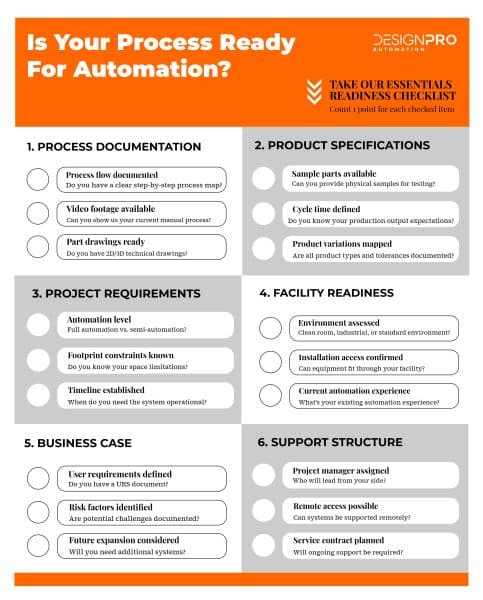
We’ve condensed our project evaluation process into a comprehensive checklist that covers all critical readiness factors. Use it to honestly assess where you stand and identify areas needing attention before moving forward.
Count one point for each item you can tick. Your total out of 18 is your automation readiness score.
1. Process Documentation
- Process flow documented – Do you have a clear step-by-step process map?
- Video footage available – Can you show us your current manual process?
- Part drawings ready – Do you have 2D/3D technical drawings?
2. Product Specifications
- Sample parts available – Can you provide physical samples for testing?
- Cycle time defined – Do you know your production output expectations?
- Product variations mapped – Are all product types and tolerances documented?
3. Project Requirements
- Automation level – Do you need full automation or semi-automation?
- Footprint constraints known – Do you know your space limitations?
- Timeline established – When do you need the system operational?
4. Facility Readiness
- Environment assessed – Is it a clean room, industrial or standard environment?
- Installation access confirmed – Can equipment fit through your facility?
- Current automation experience – What is your existing automation experience?
5. Business Case
- User requirements defined – Do you have a User Requirement Specification (URS) document?
- Risk factors identified – Are potential challenges documented?
- Future expansion considered – Will you need additional systems?
6. Support Structure
- Project manager assigned – Who will lead the project from your side?
- Remote access possible – Can systems be supported remotely?
- Service contract planned – Will ongoing support be required?
Interpreting Your Results
- 15 to 18 items: GREEN – Ready to proceed.
- 10 to 14 items: AMBER – Needs preparation.
- Fewer than 10 items: RED – More planning required.
Ready to Take the Next Step?
Automation readiness isn’t about being perfect, it’s about being prepared. Whether you’re just starting to explore automation or ready to move forward immediately, understanding your current position is the first step toward success.
Download our Automation Readiness Checklist and start your assessment today.
Have questions about your specific situation? Our team has evaluated hundreds of automation opportunities across the MedTech industry. We’re happy to discuss your process and help you determine the best path forward.

Conor Doyle, cdoyle@designproautomation.com | Patrick Downes, pdownes@designproautomation.com
DesignPro Automation specialises in custom automation solutions for the MedTech industry. With over 20 years of experience, we help manufacturers transform manual processes into efficient, reliable automated systems. Contact us at sales@designproautomation.com or +353 (0)69 63842 to discuss your automation needs.